
Why
There is growing recognition that Autistic girls may experience school differently from Autistic boys. However, existing research has largely focused on Autistic boys or on students in mainstream educational settings.
As a result, there is limited evidence regarding the experiences of Autistic girls attending autism-specific schools, highlighting an important need to better understand how these settings support their needs.
What are the experiences of Autistic girls attending autism-specific high schools, and their parents or carers?
What works well, what are the challenges and what can be improved?
The research
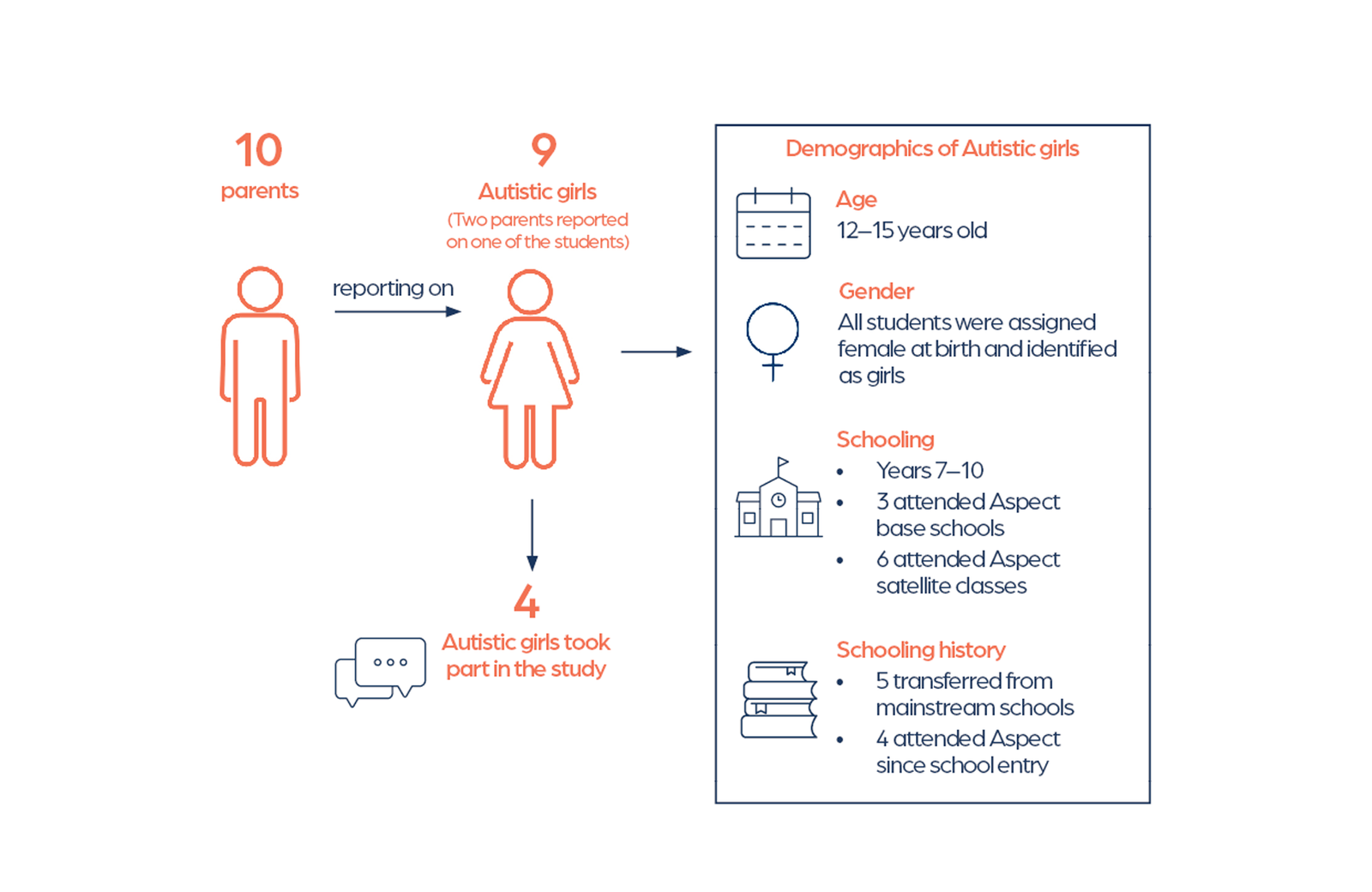
Ten parents were interviewed, along with four of their Autistic daughters, to explore what was working, the challenges or unmet needs girls experienced, and improvements that could strengthen their school experiences.
What we learnt
Overall, parents felt autism-specific schools provided a supportive environment where their daughters felt safe, understood and able to be themselves, while supporting their academic, social and developmental growth. Challenges included the predominance of boys, the wide range of needs within specialist settings, and the everyday academic and social demands of school life.
Theme 1: “Able to be herself”
Participants said school felt safe, accepting and easy to navigate, helping some girls feel confident, enjoy school , and be themselves without needing to hide who they are.
Theme 2: Supporting the whole student
Parents valued the way that schools adapted learning to individual needs while also supporting the whole student by l building on students’ strengths, developing social and everyday life skills, and working closely with families.
Theme 3: “A teenage girl in a male-dominated school”
The small number of girls limited opportunities for female friendships and shared experiences. Although some girls formed meaningful friendships with boys, several parents felt their daughters would benefit from more opportunities to connect with other Autistic girls.
Theme 4: A good fit, but not without challenges
Being in classes with students who had diverse and sometimes competing sensory, behavioural and learning needs could create difficulties for some girls. The girls also continued to experience sensory, social and emotional demands that can arise in any school environment, despite the autism-informed support available.
Recommendations
The findings identify several practical ways autism-specific schools could strengthen support for Autistic girls:
- Create regular opportunities for girls to connect across classes, campuses or schools through shared interests and experiences.
- Offer girl-focused groups covering friendships, identity, masking, puberty, relationships, social media safety and emotional wellbeing.
- Use proactive check-ins and multiple communication options to identify anxiety, sensory overload or emotional distress that may not be outwardly visible at school.
- Strengthen collaboration with families to identify changes in wellbeing, energy or behaviour that may indicate a student is struggling.
Research team
This study will be conducted by ARCAP/Aspect in partnership with Griffith University.
- Dr Vicki Gibbs
- Dr Abigail Love
- Dr Chris Edwards
- Dr Ru Ying Cai
- Ainslie Robinson
Started
2026
Ends
2026
Funding
Aspect (Autism Spectrum Australia)