

Why
Employment rates for Autistic adults are low compared to the general population. In Australia, only 42% of Autistic adults are in the workforce and many are in jobs below their skill level.
Challenges like communication differences, anxiety and stigma play a role. Employers may also have concerns about support needs, even though research shows hiring Autistic people benefits businesses without extra costs.
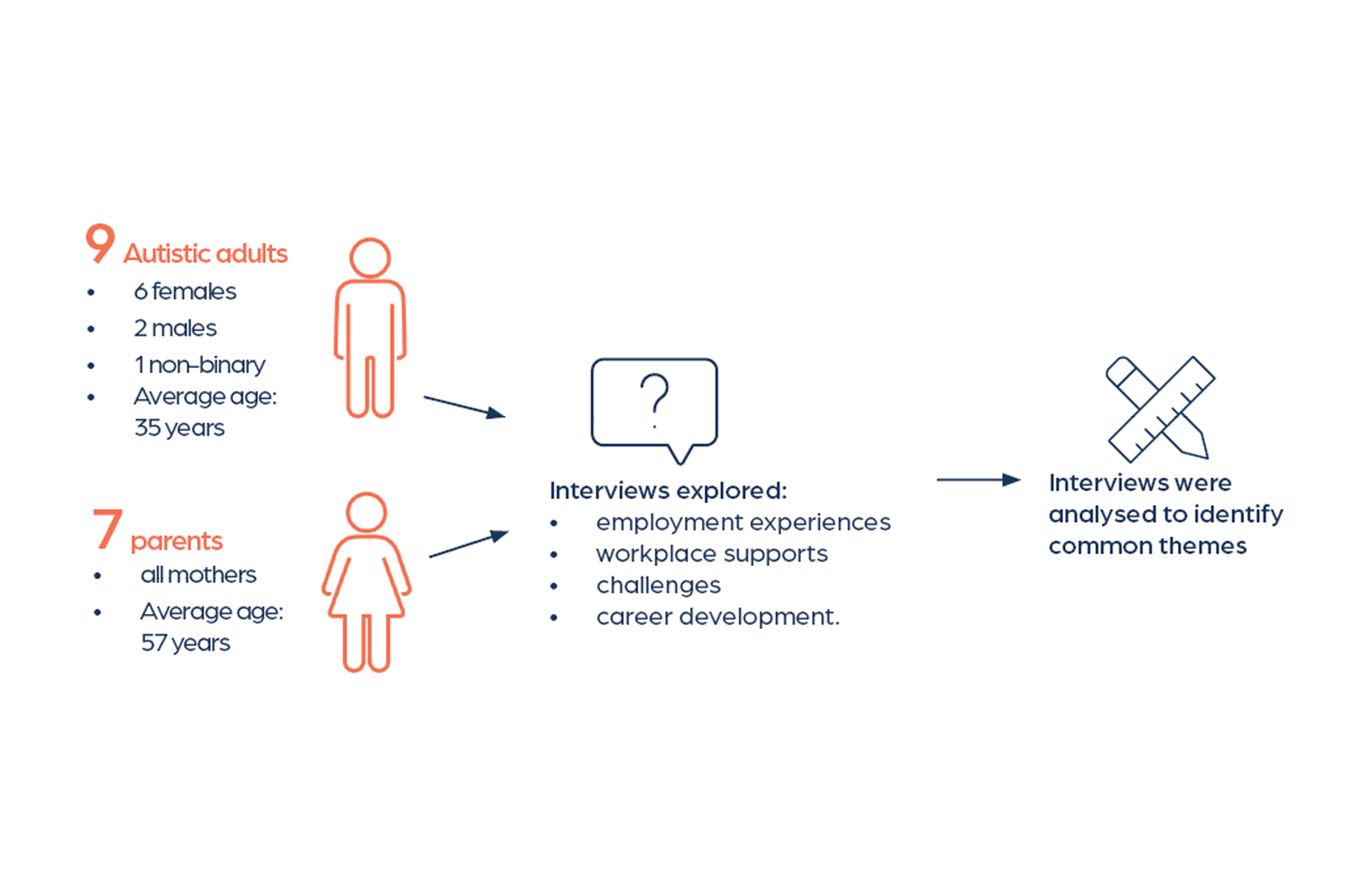
Most research studies and employment programs have focussed on large corporate and government organisations; however, nearly all businesses in Australia are small or medium sized. This study explored the experiences of Autistic adults working in SMEs, alongside the perspectives of parents supporting their children in employment.
What helps and makes it harder for Autistic people to work in small and medium businesses?
The research
Autistic adults and parents of Autistic people completed a short survey and interview.
What we learnt
Based on the interviews with Autistic adults and parents of Autistic people, four themes were identified.
Theme 1: Work as a source of personal growth and fulfilment
1.1 Having a job can “give you meaning and purpose”
Participants often described their work at the SME as valuable for reasons beyond income. Employment provided routine, purpose, achievement and a sense of contribution.
“It’s about having a job, because it gives you meaning and purpose. It’s a reason to get out of bed.” Autistic adult
1.2 Work is helpful for developing capabilities
Work at the SME provided opportunities to learn, develop capabilities and gain confidence. For some younger workers, employment offered experiences that felt different from school and helped prepare them for adulthood.
"It’s overall been a really positive experience. I think he’s got a lot of confidence.” Parent
1.3 Work as an avenue for social connection and belonging
Participants described their workplaces as places where they could build relationships, meet people and feel part of a team or community.
“There’s a sense of camaraderie between everyone.” Autistic adult
Theme 2: Navigating workplace expectations required significant effort
2.1 Navigating implicit expectations and ambiguous social norms
Participants described difficulties understanding unwritten rules, interpreting expectations and knowing what was required in different situations.
“George is not sure what people expect of him, and nobody explains it in a way that he understands.” Parent
2.2 Communicating on neurotypical terms
Many participants described adapting their communication style to fit workplace norms. This often involved careful self-monitoring and masking.
“I realised I was spending a lot of time rewording things and reworking communications and emails.” Autistic adult
2.3 Managing burnout
Participants described burnout arising from sustained social effort, high levels of responsibility and the emotional demands of work.
“I would have these mini burnouts all the time.” Autistic adult
Theme 3: “Small to medium enterprises are better suited to my needs”
3.1 SME environments perceived as more personable and human focused
Participants often compared SMEs favourably to larger organisations, describing them as more relationship-focused, approachable and supportive.
“Small businesses are much more human and people centred.” Autistic adult
3.2 Flexibility and individualised accommodations
Flexible hours, tailored responsibilities, and practical adjustments helped employees work in ways that suited their strengths and needs.
“There’s a lot more flexibility ... much easier when it’s a small business.” Autistic adult
3.3 Direct access enables wraparound support
Participants described the benefits of direct communication between employees, families, managers and support professionals while working at the SME.
“The companies have to be open to work and have us ... to give us feedback, and for us to provide them feedback, and then put steps in place. So it’s very much a two-way street.” Parent
Theme 4: Supportive management and organisational culture can shape employment experiences
4.1 Proactive and values-driven management as an enabler
Participants valued managers and/or business owners who listened, understood individual needs and worked collaboratively to find solutions.
“My bosses have created a very neuro-affirming place … when I need something or when I ask for something, they usually take my advice.” Autistic adult
4.2 SME suitability is dependent on organisational culture, leadership and values
Positive experiences were linked to organisational values, openness, and autism understanding rather than SME business size alone.
“It’s not just the size of the organisation... it’s what they actually value.” Autistic adult

Making a difference
This is the first study to focus on exploring the employment experiences of Autistic adults working in SMEs in Australia, as well as the perspectives of parents who support their children in navigating employment. The participants' insights will help us to better understand how to support Australian businesses to hire Autistic staff.
Research team
- Dr Chris Edwards: Research Fellow, ARCAP
- Dr Vicki Gibbs: Head of Research, ARCAP
- Dr Ru Ying Cai: Research Fellow, ARCAP
- Dr Abbey Love: Research Fellow, ARCAP
- Dr Emily Russo, Industry Fellow, The University of Queensland Business School
Started
2025
Ends
2026
Funding
Aspect (Autism Spectrum Australia)