
In this two-part interview, we bring together two creative voices on the autism spectrum. Tania, a young Autistic aspiring illustrator and author, sits down with illustrator Ella Brissenden following the release of Michael Theo’s new book Edward's Astonishing Animals which Ella illustrated.
Ella shares with Tania the story behind the project and how her neurodivergence shapes the way she works, creates and connects with others. Together, they explore themes of identity, representation and the strengths that come with thinking differently, offering a personal and honest look at creativity through an autistic lens.
Part 1
(Tania:) Would you be able to tell me a little bit about 'Edward's Astonishing Animals' and what first drew you to the project.
(Ella:) Well, I guess I've always wanted to do a children's book. It's been one of those bucket list things for me ever since I was a little kid. I’ve always been curious about how making a picture book works in the background - I’ve always thought it would be so cool to be able to hold something in your hand that you've made! So I’ve always wanted to do one and I'd been approached before about doing children's books by different publishers, but none of the texts had been quite right.
I think I just really wanted to work on a project that felt really meaningful and that also had a storyline that I felt like a lot of autistic kids could relate to. And I remember reading the manuscript and just thinking, man, the number of times I’d wished I was a different animal or even looked at the way someone was behaving and related it to the personalities or traits of another animal. And it felt really close to the autistic experience to be relating your thoughts and feelings and emotions to those of another animal. It just really spoke to me and I was like, I think this might be the perfect project.
Did Michael give you direction on how he wanted the illustrations to look or is the final product mostly informed by your own art style?
That's a good question. I'm very lucky that the publisher, Scholastic, were pretty happy for me to kind of do my own thing and have a lot of say over the way I wanted the book to look and the final illustration style.
Michael was involved, obviously, at all stages of the project. He saw initial sketches and gave feedback on those, but I think that he was also pretty happy for me to get the ball rolling and do it in a way that felt really authentic to my illustration style. He had a few notes and comments along the way, mostly I guess because this book is so true to him and his family and his friends. And so we definitely altered the way some of the characters looked so that they more closely resembled the people in his life. But other than that, both Michael and the team at scholastic were all pretty happy for me to kind of do my own thing, which is very lucky.
Do you have a favourite illustration or a scene in the book?
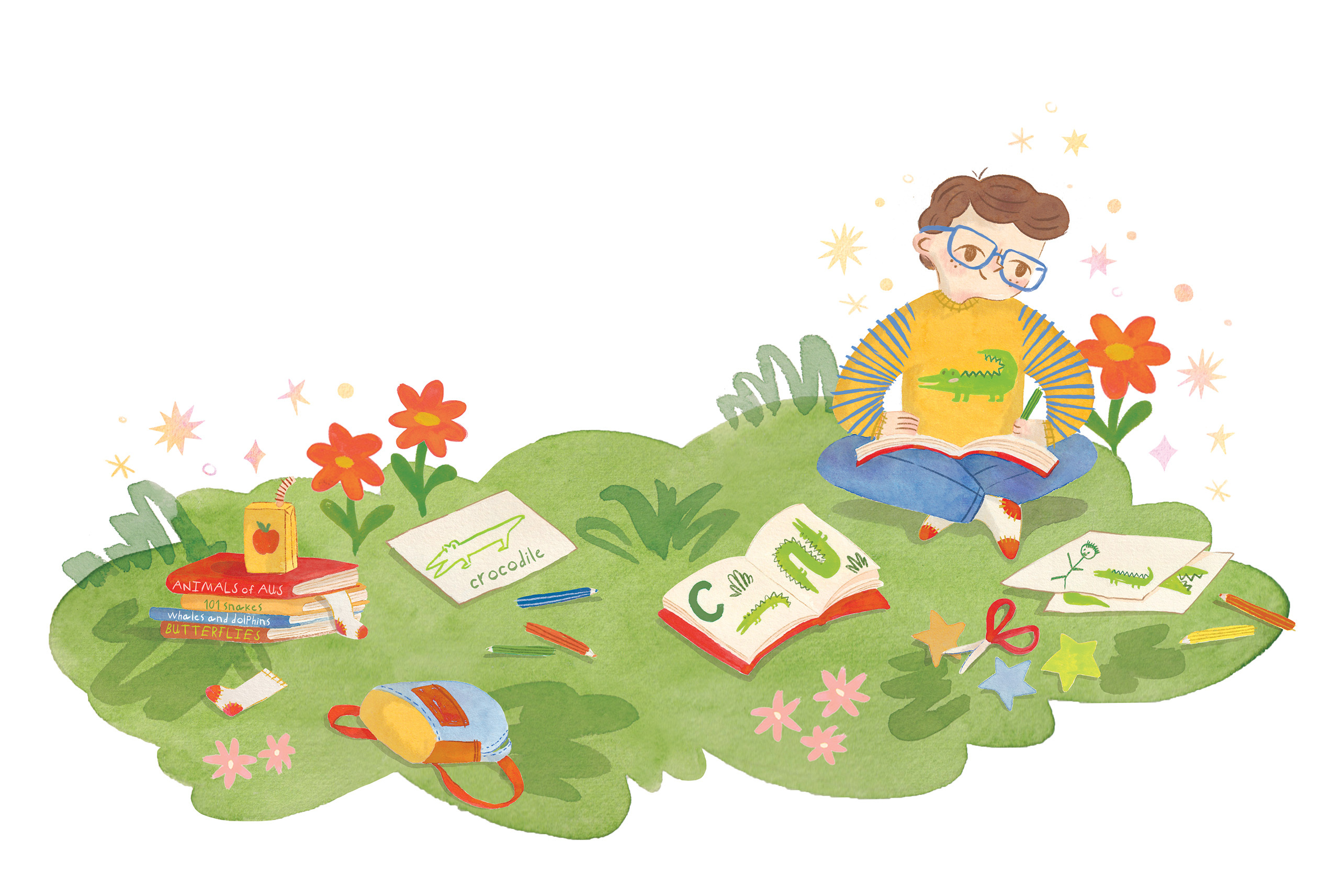
I'm so attached to all of the illustrations, but I do have a few favourites. One of my favourites is this scene of just Edward and he's standing with his hands on his hips in this big blue starry sky. I love that one. And there's also this big double page spread halfway through the book where Edward's transformed into a bear, and he's got all his friends sitting around him in the library. And I love that scene too. And then the other one is the second or third page of the book. There's this fridge scene with lots of photos of Edward and his family and receipts of them going to the zoo, and their collection of fridge magnets and stuff. The publishers asked me to draw something that introduces Edward and his family to the readers and there's no better way to get to know someone than to take a look at their fridge! I'm really proud of that one, it was a really fun scene to draw.
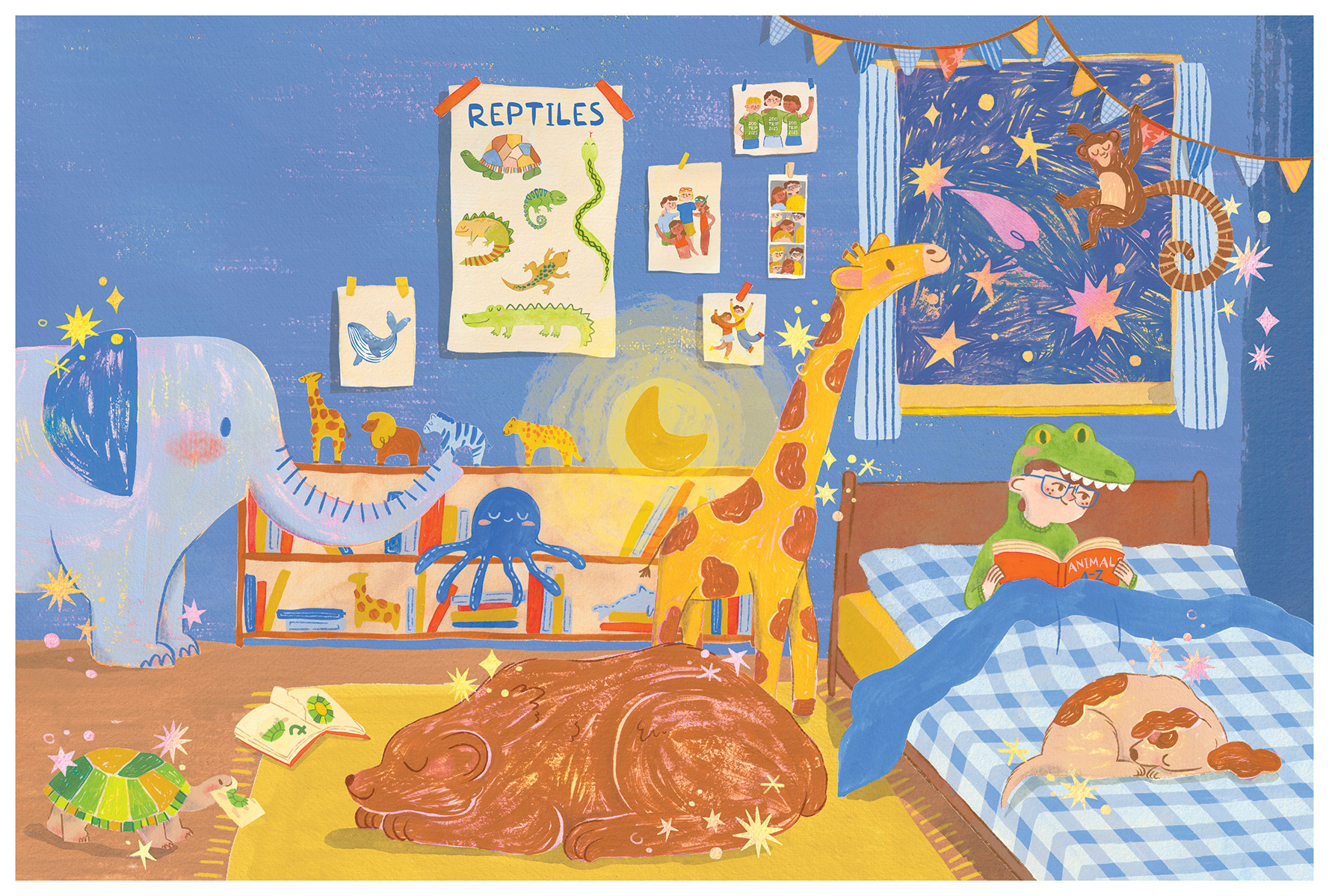
Like we said, the illustrations are very detailed as you were talking about the fridge. In Edward's bedroom, you can see his tiger onesie, animal posters, books about animals and animal figurines. And so as both you and Michael are on the autism spectrum, was it easy to imagine how Edward's special interest might be expressed in his everyday life?
I was thinking about the things that I really love, and the way that I want them everywhere and all over the walls. And it's always been like that, even when I was a little kid, covering the walls with the things that I was obsessed with at the time. I was just thinking back to my own personal childhood bedroom and, probably the bedrooms of all autistic kids with special interests, and how every element of your life just ends up being overtaken by it. So it just felt really natural and important to create scenes that really reflected that. And also when you look at a kid's book, there's nothing better than seeing all of these little details that you just grab onto. All those details are so intentional, I realise now, having made the book. Drawing all of this extra stuff that kids can go, oh my gosh, that's so cool. That's the best part about kids' books. So the more detailed, the better, I guess!
Would you say that there's strengths you bring to your work as an illustrator that you feel are connected to the way that you experience the world as a neurodivergent person?
I probably think outside the box more than the average illustrator does. My brain just works a bit differently. It's funny when you get given the manuscript, there often isn't actually a lot of direction in terms of the illustrations.
So you just get given this manuscript and somehow you have to make a 32 page book out of it. And without much direction, you have to figure out how to turn these words into something that a kid would want to look at that has visual appeal. And I think that my brain just really loves that challenge of figuring out how to take these words and turn them into a story that feels all-encompassing, detailed and also relatable. I think my brain really loves that.
For example, the idea of him switching between wearing animal onesies in some scenes and transforming into animals in another scene, that was my idea. My brain just loves the challenge of imagining how this idea would work in real life. Like obviously he wouldn’t actually turn into an animal if we were in an average primary school, right? So how do we tell that story in a world where maybe he just loves animals so much, he has a collection of animal onesies that help him pretend to become different animals. So I think it helps having a brain like mine with this sort of stuff because you can really think outside the boundaries of the manuscript you've been given.
More autistic people are sharing their own stories through books, television and the arts. What changes have you noticed in recent years?
There's definitely more conversations happening around what it means to be an Autistic person in the world and the challenges that come with that, but also how valuable the autistic brain is and how much society needs neurodiverse people to create this big, beautiful, creative world that we live in. And so I think that's really great. There was so much stigma early on when I was first diagnosed, and now I feel like the conversation's changing a little and I'm really happy about that. I think it's great to see more people across books, television and the arts be openly proud of their autistic identity, and showing the world that we can live full, wonderful lives when we have access to the support we need. I want everyone to be able to just see regular autistic people living their best lives, and for the next generation of neurodiverse kids to know it's possible for them too!
Do you have any advice for aspiring illustrators? Would you give any like particular advice for young people who dream of writing or illustrating books?
Make the kind of art that you want to make and see in the world, and eventually the right people will find your artwork and things will just happen. Just be true to yourself and the kind of artwork that you love, and the right people will find it in the end.
Enjoying this conversation with Ella? Continue to Part 2 to learn more about her creative process, representation and advice for aspiring illustrators.
_________________________________________________
From EDWARD’S ASTONISHING ANIMALS by Michael Theo and Ella Brissenden
Text copyright © Michael Theo, 2026.
Illustrations copyright © Ella Brissenden, 2026.
First published by Scholastic Press, a division of Scholastic Australia Pty Limited, 2026.
The moral rights of Michael Theo and Ella Brissenden have been asserted.
Reproduced by permission of Scholastic Australia Pty Limited.