 Saved resources
Disclosing you are Autistic in the workplace
There’s a moment many Autistic professionals know too well. You disclose you're Autistic, and you watch the other person pause. Calculating what that means about you, your work, your worth.

It's a response that’s meant to be reassuring. It rarely is. It reflects the assumptions people carry about what Autism looks like, and who belongs in healthcare. For many Autistic professionals, disclosure is rarely a simple or neutral act. It carries weight. It invites assumptions. And it often leaves people wondering whether they’ve just opened a door or walked into a trap.
Some choose never to share, it can be a deeply personal decision. Others test the waters gently, with trusted colleagues or in safer spaces. For some, disclosure is essential. To advocate. To role model. To stop apologising for what they need. But the stakes are real. Some Autistic people have felt that disclosing can feel like career or professional suicide. In some cases, people have shared that disclosure led to job loss, bullying, or serious mental health consequences.
There are still spaces where being Autistic is seen as incompatible with being a good healthcare professional. As if empathy only looks one way. As if Autistic people can’t manage complexity, connect with patients, or work in teams. As if they don’t belong.
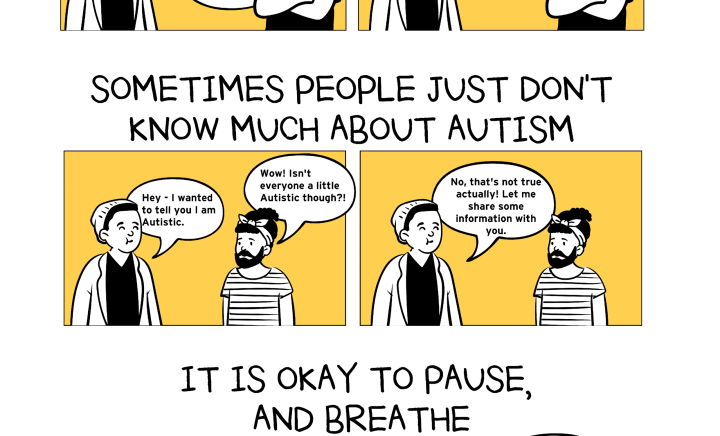
Sometimes, disclosure isn’t just met with disbelief. It’s treated like a debate:

The fear of being disbelieved is common. So is the reality of being treated differently. Some have seen their roles change the moment they speak up. Others are still waiting for their workplace to be safe enough to say it at all.
But when it goes well, disclosure can shift the culture. A client relaxes. A colleague rethinks. A team adjusts. It’s not always dramatic, but it matters. Visibility makes space for others. Sometimes it’s what makes someone feel like they can stay.

Still, it shouldn’t be necessary to disclose in order to be treated with dignity. No one should need to offer a diagnosis to explain their communication style, or to justify an adjustment. Safety and support should not be conditional.
We need environments where difference is expected. Where Autistic professionals are part of the picture, not an exception to it. Where adjustments are offered without people having to ask, and disclosure is never used as a reason to question someone’s place.
If you’re an Autistic healthcare professional, whether you disclose or not, your experience is valid. You are not alone. And you shouldn’t have to trade safety for honesty.
You belong here. You always have.
Cecilia's perspective
In this video, Cecilia, a social worker in a public hospital, shares that she is still cautious about disclosing her neurodivergent identity at work. While she is gradually opening up to more colleagues, she remains apprehensive due to concerns about how people, both in the workplace and in broader society, respond to Autistic individuals.
Autism disclosure guides
Researchers from the Aspect Research Centre for Autism Practice (ARCAP) have used findings from their disclosure studies to design resource guides aimed at making the disclosure process more positive and successful for Autistic people and to inform those who support them.
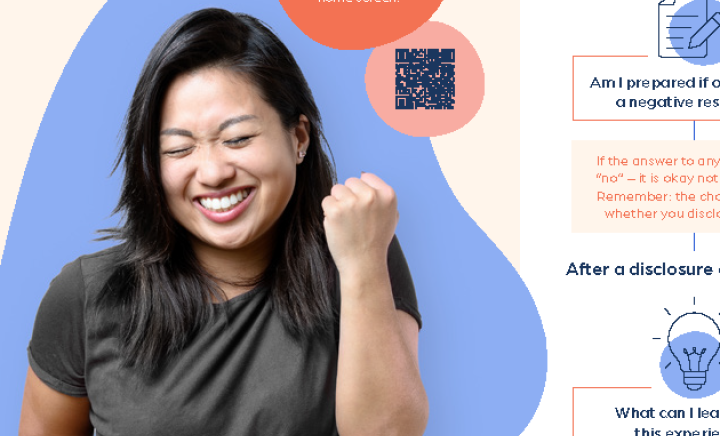
Autism disclosure – a guide for Autistic people

Autism disclosure – creating inclusive communities